
«There was a man of the Pharisees named Nicodemus, a ruler of the Jews. He came to Jesus by night…»
— John 3:1-2
There are encounters with Jesus Christ that transform a life in an instant.
And there are others that begin a silent battle that can last a long time.
When we think of Nicodemus, we usually remember the famous dialogue about being born again. However, we rarely stop to contemplate the process God was carrying out in that man’s heart.
Nicodemus was not just any man.
He was a Pharisee.
He was a teacher of Israel.
He was a member of the Sanhedrin.
He was respected by society and recognized for his knowledge of the Scriptures.
But that night he discovered a truth that shook the foundations of his entire religious life.
He did not need more knowledge.
He needed a new life.
Jesus said to him:
«Truly, truly, I say to you, unless one is born again, he cannot see the kingdom of God.»
— John 3:3
Those words were not simply another teaching.
They were a call to begin again.
When knowledge is no longer enough
Nicodemus knew the Law.
He knew the prophets.
He knew the promises.
But he still did not fully know the Messiah who stood before him.
Jesus even asks him:
«Are you a teacher of Israel, and yet you do not know these things?»
— John 3:10
How remarkable.
It is possible to know a great deal about God…
…and still need a true encounter with Jesus Christ.
That still happens today.
We can know doctrine.
We can attend church.
We can quote verses.
But only Christ can give life to the heart.
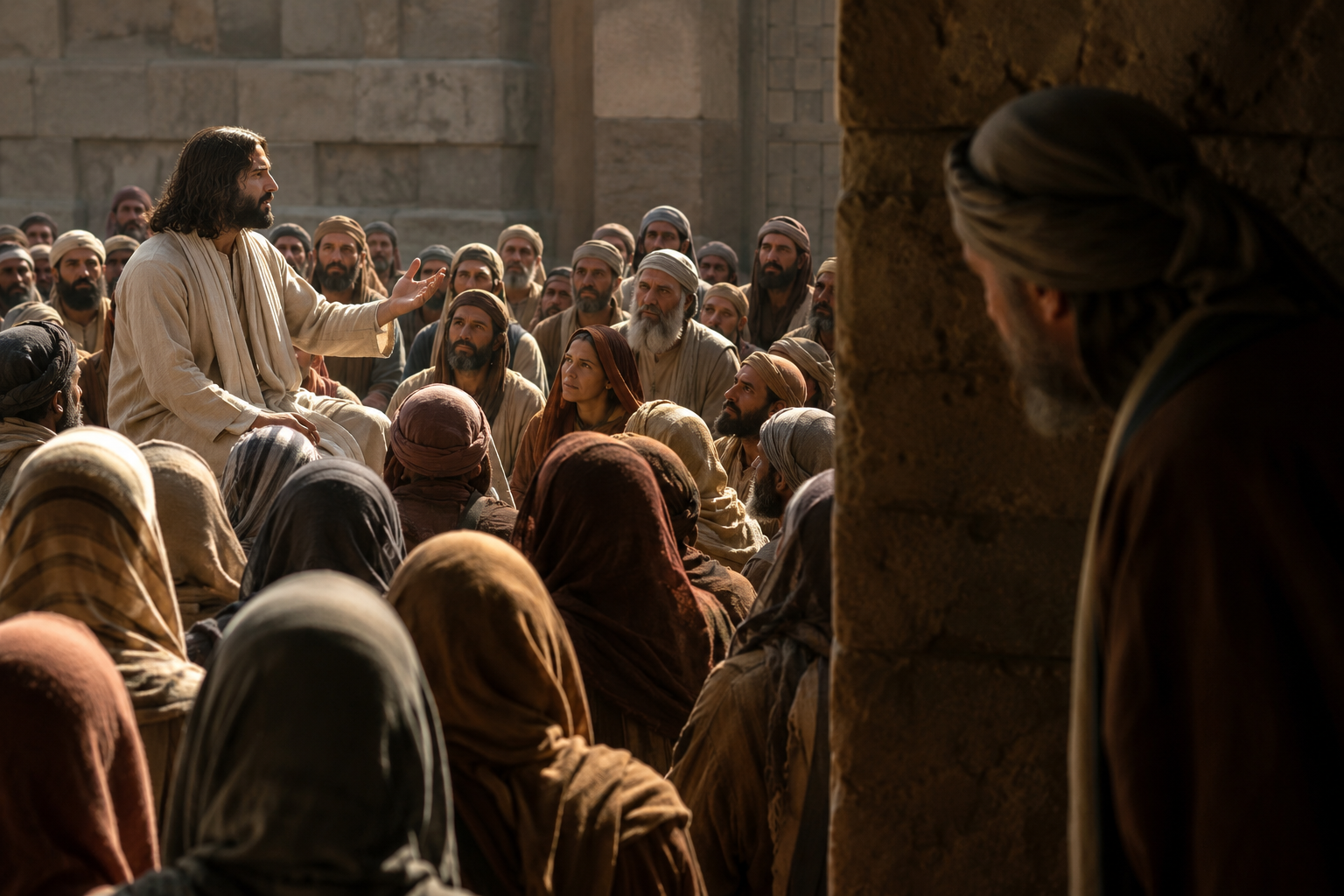
The battle the Bible hints at
Scripture does not tell us what happened within Nicodemus during the following months.
It does not record every conversation.
It does not describe every struggle.
It does not reveal every tear.
And precisely because of that, we must be prudent.
It would not be right to assert events that God decided not to reveal.
However, we can observe something evident in the Gospel of John.
Nicodemus appears three times.
In John 3, he comes at night.
“There was a man of the Pharisees named Nicodemus, a ruler of the Jews. He came to Jesus at night…” John 3:1-2
In John 7, he begins to defend justice before his fellow leaders.
“Nicodemus, the one who came to Him by night, who was one of them, said to them:” John 7:50
And in John 19, he appears beside the cross.
“Nicodemus also, who had previously visited Jesus at night, came bringing a mixture of myrrh and aloes, about a hundred pounds.” John 19:39
It is not difficult to perceive a growth.
Something was happening within that man.
His encounter with Christ had begun a process that could no longer be stopped.
A Struggle That Still Exists
Although the story belongs to the first century, the battle continues in our day.
Many feel Christ’s call.
Their conscience has been touched.
Their heart knows that Jesus is Lord.
But another voice begins to speak.
“What will my family say?”
“What will my friends think?”
“Will I lose my reputation?”
“Will I be rejected?”
Not everyone rejects Christ out of disbelief.
Many struggle because following Him comes at a cost.
Jesus Himself taught:
“The one who loves father or mother more than Me is not worthy of Me.”
— Matthew 10:37
And He also said:
“For whoever is ashamed of Me and My words, the Son of Man will be ashamed of that person when He comes in His glory.”
— Luke 9:26
These words continue to confront our hearts.

Sunday Christians… secret disciples during the week
The story of Nicodemus also compels us to examine ourselves.
Not because we can assert that he remained hidden all that time.
The Bible does not say that.
But it does invite us to ask whether we ourselves are living a hidden faith.
Some people worship the Lord freely within the church…
…but during the week no one knows that they belong to Christ.
At work, they remain silent.
With their friends, they hide their faith.
In conversations, they avoid mentioning the Lord’s name for fear of being rejected.
It is as if there were believers who live like secret agents.
But the Gospel was never designed to remain hidden.
Jesus said:
«You are the light of the world… A lamp is not lit and put under a bushel.»
— Matthew 5:14-15
Light was made to shine.
From Silence to Courage
Later, we find Nicodemus again.
When the chief priests want to condemn Jesus, Nicodemus intervenes.
He does not give a great speech.
He does not publicly proclaim that he is a disciple.
But he no longer remains completely silent.
He asks:
«Does our law judge a man without first hearing him and finding out what he has done?»
— John 7:51
It seems like a small step.
But many times, transformation begins precisely this way.
With one step.
With a decision.
With a voice that finally dares to speak.
The True Victory
Then something extraordinary happens.
Jesus has been crucified.
The disciples are filled with fear.
Everything seems to have ended.
And then Nicodemus appears.
He does not come at night.
He does not arrive in hiding.
He is not looking for answers.
Now he comes with Joseph of Arimathea, carrying a large quantity of myrrh and aloes to prepare the Lord’s body.
«Nicodemus, who had previously visited Jesus at night, also came, bringing a mixture of myrrh and aloes…»
— John 19:39
John does something very interesting.
He does not need to explain who he is.
He simply writes:
«…the one who had previously visited Jesus at night.»
It is as if he wanted the reader to remember where it all began.
The man who sought Jesus under the protection of darkness…
Now appears publicly identified with the Crucified One.
What a difference.
What a transformation.
What a wonderful work Christ does in a surrendered heart.
God's Process: A Work He Himself Will Finish
Many times, we want to see instant changes.
We want a person to be transformed immediately, for all their doubts to disappear, for their fears to be overcome, and for their commitment to Christ to be complete from the very first encounter.
However, God also works through processes.
Peter needed to be broken and restored.
Thomas had to be confronted in the midst of his doubts.
John went from being called “son of thunder” to being known as the apostle of love.
And Nicodemus seems to have traveled a path that began in the darkness of night and ended publicly beside the cross.
We do not know every step of that process. The Bible does not reveal all of his struggles, thoughts, or decisions to us. But we know the God who transforms hearts.
“Being confident of this, that he who began a good work in you will carry it on to completion until the day of Jesus Christ.”
Philippians 1:6
What powerful words!
Paul does not say that God might finish the work.
He does not say that He will try to finish it.
Nor does he declare that He will complete it only if circumstances turn out favorably.
Paul writes with extraordinary confidence:
“Being confident of this…”
It was not merely human hope or an optimistic desire. It was a firm conviction based on the character, faithfulness, and power of God.
Paul’s assurance did not rest on the ability of the believers in Philippi to sustain themselves. It rested on the One who had begun the work within them.
Let us observe the order of the verse:
“He who began…”
It does not say: “The work that you began.”
Salvation did not first originate in the heart of man. It originated in the heart of God. He was the One who sought us, called us, opened our eyes, and awakened in us the desire to draw near to Christ.
Jesus declared:
“You did not choose me, but I chose you…”
— John 15:16
Furthermore, Paul himself wrote:
“For it is God who works in you to will and to act in order to fulfill his good purpose.”
Philippians 2:13
The God who produces in us the desire to obey is also the One who gives us the strength to do so.
He begins the work.
He sustains the work.
And He will carry that work through to the fulfillment of its purpose.
God’s faithfulness does not eliminate our responsibility
This promise does not mean that the believer should remain idle, passively waiting for God to transform them while continuing to live in any manner they please.
The assurance of Philippians 1:6 is not an excuse for spiritual indifference. It is a source of confidence for walking in obedience.
Paul also wrote:
“Work out your salvation with fear and trembling.”
— Philippians 2:12
That verse points to our responsibility.
We must seek the Lord, obey His Word, resist sin, cultivate our fellowship with Christ, and respond in faith to the work of the Holy Spirit.
However, immediately afterward Paul explains why we can do this:
“For it is God who works in you to will and to act in order to fulfill his good purpose.”
Philippians 2:13
There we find the balance.
We walk, but God gives us the strength.
We obey, but He works in our hearts.
We persevere, but it is His grace that sustains our perseverance.
Our faith must be active, but our faith does not sustain God’s faithfulness. God is the One who sustains our faith.
We must not interpret Philippians 1:6 as if it said: “It does not matter what you do; God will finish His work while you continue resisting Him.” The true work of God in a person produces repentance, a hunger for truth, a desire to obey, and a growing conformity to Christ.
The grace that saves also teaches us how to live.
“For the grace of God has appeared, bringing salvation to all people, teaching us that, renouncing ungodliness and worldly desires, we should live self-controlled, upright, and godly lives in this present age.”
— Titus 2:11-12
God was working in the silence
Now let us think again about Nicodemus.
What happened between his conversation with Jesus in John 3 and his appearance beside the cross in John 19?
Scripture does not explain it to us.
We do not know how many nights he remembered the Teacher’s words.
We do not know how many times he struggled between the truth he had heard and the position he held among the rulers of Israel.
We do not know whether he heard Jesus again among the crowds, nor how many opportunities he had to decide between remaining hidden or identifying himself with Him.
We must not turn those possibilities into biblical facts.
But we can affirm this: between the night and the cross, God was at work.
While Nicodemus struggled, God was at work.
While Nicodemus reflected, God was at work.
While Nicodemus timidly began to raise his voice, God was at work.
When in John 7 he asked whether the law could judge a man without hearing him first, perhaps he still was not making a complete public confession, but he was no longer remaining entirely silent.
“Does our law judge a man without first hearing him and finding out what he has done?”
— John 7:51
Then, in John 19, we find him bringing a large quantity of myrrh and aloes to prepare Jesus’ body.
“Nicodemus also, who had first visited Jesus at night, came bringing a mixture of myrrh and aloes…”
— John 19:39
The man who first approached under the protection of darkness now identified himself with Christ before everyone.
Perhaps Philippians 1:6 allows us to understand spiritually that silence between John 3 and John 19:
God was perfecting the work He had begun.
God Does Not Abandon the Work of His Hands
The word “perfect” does not mean that the believer will attain a life completely free from sin before Christ’s coming.
It means bringing a work to completion, leading it toward the goal for which it was begun.
God does not work like someone who starts many projects and then abandons them halfway through.
He does not leave the work of His hands unfinished.
The psalmist declared:
“The LORD will fulfill His purpose for me; Your mercy, O LORD, endures forever; do not abandon the work of Your hands.”
— Psalm 138:8
God does not merely want to take us to heaven. His purpose is to form in us the character of His Son.
“For those whom He foreknew, He also predestined to be conformed to the image of His Son…”
Romans 8:29
That is the goal of the work.
That we think more like Christ.
That we speak more like Christ.
That we love more like Christ.
That we obey as Christ did.
That each day the dominion of the old self would diminish in us, and the life of the Son of God would be seen more clearly.
That is why the process sometimes includes correction, waiting, brokenness, and struggles that we do not immediately understand. But the Potter has not let go of the clay.
God does not abandon the work His hands began. He does not save a person and then turn away from them. The same Christ who confronted Nicodemus that night continued working silently until He led him to the place where he would have to decide whether to remain hidden or identify himself with the Crucified One.
He works the same way with each of His children.
While we see struggles, delays, and processes, God continues chiseling the heart according to the image of His Son.
A promise that urges us to continue
Our hope does not rest on the strength of our own perseverance, but on the faithfulness of the God who promised to complete the work He began.
But that certainty does not lead us to passivity.
It urges us to rise when we fall.
It moves us to keep believing when we do not see immediate results.
It encourages us to obey when the path becomes difficult.
It helps us understand that God does not waste a single tear, struggle, or step taken by those who belong to Him.
Perhaps someone today is still in the midst of their process.
They have had an encounter with Christ, but they continue struggling with fears, doubts, old habits, or the opinions of others.
Philippians 1:6 does not invite you to settle into that condition. It reminds you to continue responding with faith and obedience to the God who is working within you.
The Lord is not finished.
As long as there is conviction, repentance, a hunger for His Word, and a desire to draw closer to Jesus Christ, there is evidence that God continues to work.
We must not be content to remain in the night when Christ is calling us into the light.
Nicodemus had to move from a private conversation to a public identification with Jesus.
And every believer must also allow God's inner work to become a visible life of obedience, faithfulness, and testimony.
For the God who began the good work is faithful to complete it until the day of Jesus Christ.
Final Exhortation
The story of Nicodemus does not end by asking us a question about him.
It asks us a question about ourselves.
Where are we today?
Are we still hiding our faith out of fear of people's opinions?
Do we know Christ only in private?
Or are we willing to identify with Him, even when it comes at a cost?
One day we will appear before the Lord.
We will not be evaluated by the applause of the world.
Nor by our reputation.
Nor by our position.
But by the One who knows the heart perfectly.
«For we must all appear before the judgment seat of Christ…»
— 2 Corinthians 5:10
And perhaps the deepest lesson Nicodemus leaves us with is this:
Nicodemus's true victory did not occur when he found Jesus at night. It happened when he stopped hiding and stood beside the cross.
May that also be our victory.
Not to live a hidden faith.
But to follow Christ faithfully, to the end.
«If anyone serves Me, let him follow Me; and where I am, there My servant will be also.»
— John 12:26