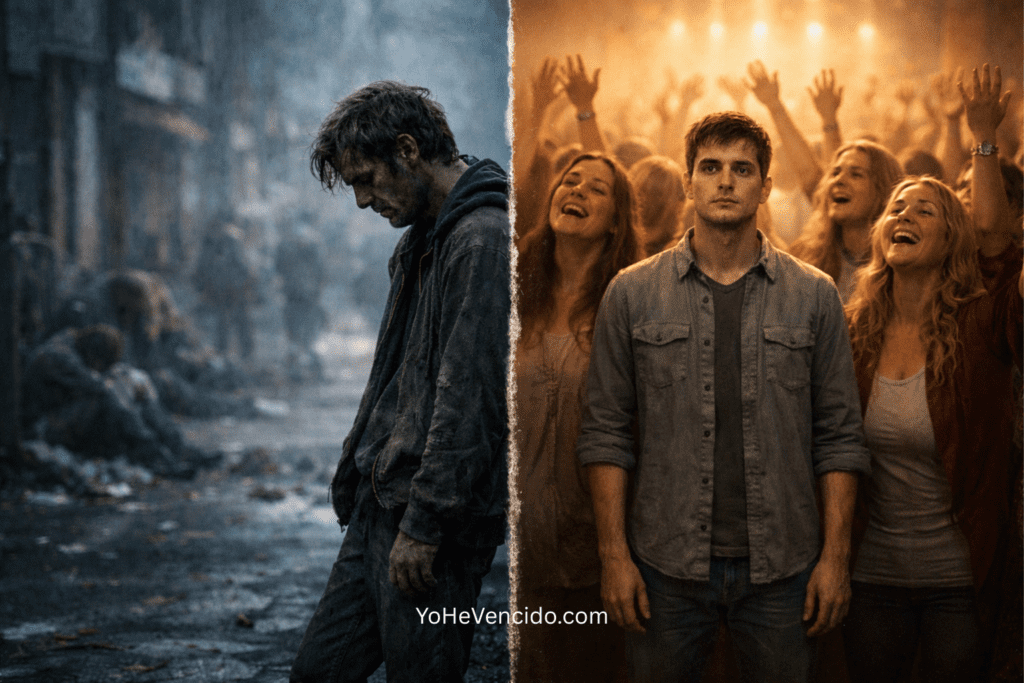
Spiritual Zombie in the Church
An urgent call to awaken from spiritual lethargy
Introduction
When we think about zombiesOur minds often turn to fiction: films, series, or stories featuring bodies that walk without will, without consciousness, and without purpose. Beings that move, but do not live; that react, but do not feel.
However, outside of fiction, realities exist today that compel us to use that same word as a metaphor. In many cities, one can see people enslaved by drugs, with vacant stares, their will broken, and their identities shattered. They are not monsters; they are human beings trapped in a visible state of slavery.
What is most disturbing is that this image doesn't only exist on the streets.
It can also exist inside the church.
People who stand in the midst of worship, surrounded by joy, singing, and raised hands, but whose hearts remain distant, dull, and disconnected from the life of God. They are not under the influence of any substance, but they live spiritually anesthetized.
We call this condition "spiritual zombie" in the church.
And it is a reality that the Word of God had already warned about.
In the modern church there exists a dangerous and silent condition: the spiritual zombie.People who are physically present, but disconnected from life, joy, and the fire of God.
This is not an exaggeration or a flippant judgment. It is spiritual discernment.
I'll say it carefully, but truthfully:
There are spiritual zombies inside the church.
Not because of chemical drugs, but because absence of spiritual life.
Scripture confirms that this condition can exist. within the people of God:
“Examine yourselves to see whether you are in the faith; test yourselves.”
(2 Corinthians 13:5)
The spiritual zombie in the church
It's not someone who doesn't believe. It's someone who affirms faith in their mind, but whose life doesn't reflect a living and constant relationship with God.
It's not that he doesn't attend. He's present at services and activities, but his heart remains distant and disconnected.
He is not someone who doesn't sing. He participates in worship with his lips, but without an inner surrender born of the Spirit.
This is someone who:
This physically presentbut spiritually absent
Has Christian languagebut worldly mind
He knows hymns, but does not listen to the voice of God
He reacts out of habit, not conviction.
Live by routine, not by faith.
Jesus said it without gentle metaphors:
“This people honors me with their lips,
But her heart is far from me.”
(Matthew 15:8)
And he also warned:
“Not everyone who says to me, ‘Lord, Lord,’ will enter the kingdom of heaven…”
(Matthew 7:21)
They're not drugged... but they're anesthetized
They are not under the influence of any substance, but their spiritual sensitivity has been fading over time. Their conscience no longer responds with the same clarity, their convictions no longer feel uncomfortable, and the voice of God seems distant or irrelevant. It is not a sudden loss, but a gradual numbing brought on by routine, comfort, and a lack of genuine communion.
Here's the key difference: The addict seeks anesthesia to escape the pain, the spiritual zombie lives anesthetized because he has stopped confronting his condition before God.
One consciously flees; the other remains unaware that he has lost his spiritual sensitivity.
The chemical addict seeking anesthesia.
The spiritual zombie He lives anesthetized.
Anesthetized by:
Religious routine
Tradition without revelation
Activism without privacy
Knowledge without obedience
Misunderstood grace (without repentance)
The Word describes it like this:
“They are always learning, but they can never arrive at the knowledge of the truth.”
(2 Timothy 3:7)
They lack conviction.
They don't feel any urgency.
They feel no burden for souls.
And most alarmingly: They do not feel hunger for God.
“Blessed are those who hunger and thirst for righteousness, for they will be filled.”
(Matthew 5:6)

Appearance of life, but without spiritual life
This is nothing new. Paul accurately described it when he warned about people who maintain an outward form of piety but lack God's transforming power within. These are lives that appear to be aligned with faith, but where there is no evidence of surrender, obedience, or spiritual fruit. There is religious activity, but no fellowship; there are correct words, but no conviction. The result is a superficial faith that looks alive on the outside but remains barren within.
“They will have a form of godliness,
but they will deny its effectiveness.”
(2 Timothy 3:5)
Appearance but lifeless
Movement but without direction
Noise but no fire
A spiritual zombie walks,but he does not live a life in the spirit.
A spiritual zombie answer,but does not decide with discernment.
“For the kingdom of God is not a matter of talk but of power.”
(1 Corinthians 4:20)
How is a spiritual zombie formed?
It didn't happen overnight. It's the result of a slow and silent process, in which small, seemingly harmless concessions are made. Little by little, the Word is neglected, prayer grows cold, and attitudes that once troubled the conscience are tolerated. Without realizing it, the spiritual life goes on autopilot until the relationship with God is replaced by habits and customs.
It was because of:
Abandoning the Word
Turn off the prayer
Neglecting fasting
Negotiating sin
Justifying lukewarmness
Trading conviction for comfort
Scripture clearly warns:
“Because you are lukewarm—neither hot nor cold—I am about to spit you out of my mouth.”
(Revelation 3:16)
Nobody wakes up one day saying:
“Today I will be a spiritual zombie.”
He falls asleep little by little.
“Therefore be careful how you walk, not as unwise but as wise.”
(Ephesians 5:15)
The greatest danger of the spiritual zombie in the church
The spiritual zombie doesn't know he's dead. That's the real danger. Because he doesn't perceive his condition, he feels no urgency to repent or need to change, because everything seems "normal" from the outside. Habit replaces life and familiarity with the sacred, extinguishing the sense of dependence on God. When there is no awareness of spiritual death, there is also no cry for life.
Jesus spoke to a church like this:
“You have a name that says you live,
But you're dead.
(Revelation 3:1)
I was not outside the church.
It was the church.
“If you do not watch, I will come upon you like a thief…”
(Revelation 3:3)
Hope: Christ still gives life
Unlike the fictional zombie, whose condition is beyond redemption, spiritual death is not final when Christ intervenes. Jesus did not come to mask appearances or uphold religious routines, but to impart true life where all seemed lost. Where the heart has grown cold, He can rekindle the flame; where faith has become mechanical, He restores communion. In Christ, even those who have fallen into spiritual lethargy can awaken and live life to the full.
The spiritual zombie can awaken.
Christ did not come to improve corpses,
wine to to give true life.
“I have come that they may have life, and have it to the full.”
(John 10:10)
“Wake up, you who sleep,
and rise from the dead,
and Christ will enlighten you.”
(Ephesians 5:14)
Final exhortation to the church
Church, this is not a time to live on autopilot. This is not a time for religion without fervor, nor for worship without commitment. We live in times when spiritual distraction has become normalized and vigilance has weakened. When the heart grows dormant, faith becomes vulnerable.
The Word clearly warns us:
“Be sober-minded; be watchful. Your adversary the devil prowls around like a roaring lion, seeking someone to devour.”
(1 Pedro 5:8)
This warning was not written for unbelievers, but for believers. A careless heart, an unguarded faith, and a spiritual life on autopilot open the door to burnout, deception, and spiritual apathy. The enemy doesn't need to destroy everything at once; often, it's enough for the believer to stop watching.
Therefore, this is a call to awaken, to examine our hearts, and to return to a living and conscious relationship with God. It is not enough to be in the right place if our souls are distracted. Today more than ever, the church needs less habit and more discernment; less routine and more dependence on the Lord.
“Today, if you hear his voice, do not harden your hearts.”
(Hebrews 3:15)
The call is not to point fingers,
that regret.
It's not about judging,
that return to first love.
“Remember therefore from where you have fallen, and repent.”
(Revelation 2:5)
A call for personal self-examination
This is a moment to pause and look honestly at yourself before God. Not to compare yourself to others, nor to justify your own condition, but to allow the Holy Spirit to reveal what needs to be confronted. If reading these words stirs something in your heart, don't ignore it or put it off; take it to Christ in a private, sincere, and personal prayer. Because although the prayers of others for you are valuable, no profound change occurs without a genuine encounter between you and God. You and your Lord and Saviorwhere the condition is acknowledged and transformation is longed for. Without that personal act of surrender, everything can remain the same on the outside, while the heart remains lifeless within.