The Pain of Christ: The Price of the Love That Gave Us Eternal Life
Introduction
The suffering of Jesus Christ did not begin on the cross.
It began on a dark night of betrayal, injustice, and silence, when He who is Truth was handed over by one of his own and judged by men who had already decided his fate.
Jesus was arrested in Gethsemane, taken from court to court, falsely accused, beaten, spat upon, and mocked. He was brought before the religious council, then before the Roman governor, and finally exposed before a crowd that, blinded by piety and pressure, shouted: “¡Crucify him!” (Luke 23:21).
The trial was illegal, rushed, and merciless.
The punishment was cruel, excessive, and humiliating.
Isaiah had foretold it centuries before:
“Distressed and afflicted, He did not open His mouth;
He was led like a lamb to the slaughter…”
(Isaiah 53:7)
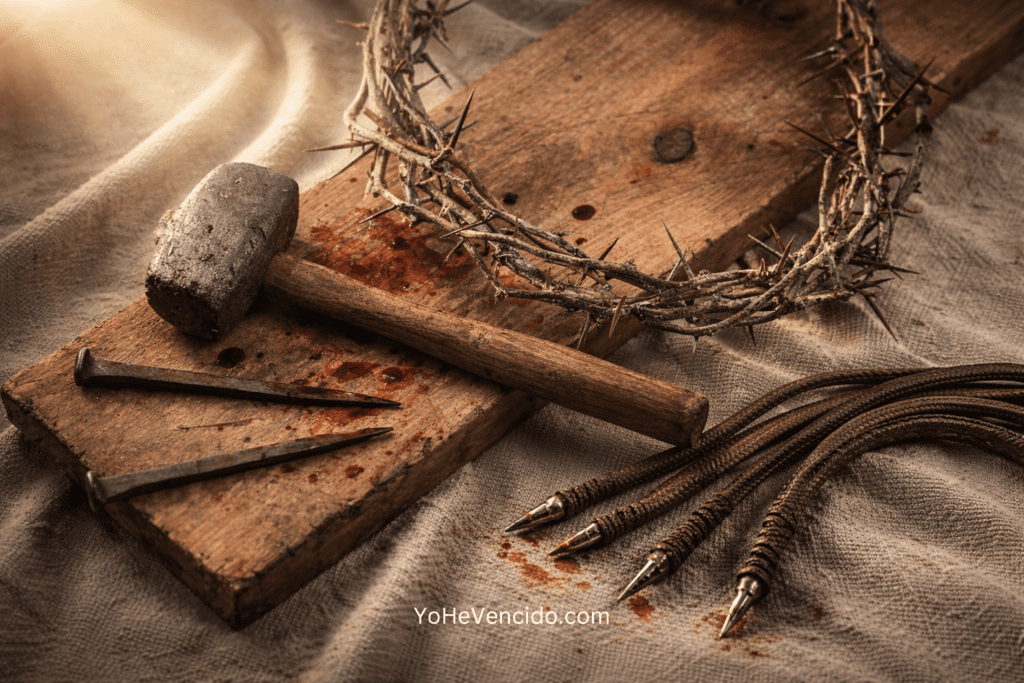
Jesus was violently flogged. The soldiers did not merely carry out a sentence; they unleashed upon Him a brutality intended to break His body before the cross. Then they placed a crown of thorns upon His head, dressed Him in mockery, and knelt before Him in feigned honor, while they beat Him again and again (Matthew 27:27–30).
All of this happened before that he would carry the wood.
However, the greatest burden was not that of the blows nor that of the cross.
The greatest weight was the sin of the world laid upon Him.
“But He was wounded for our transgressions,
crushed for our sins;
"The punishment that brought us peace was upon Him..."
(Isaiah 53:5)
Jesus was not a victim of circumstances.
He was not surprised by the pain.
He was not forced to love.
He consciously walked into suffering, submitting to the Father's will, to fulfill an eternal plan of redemption.
And Scripture reveals to us the ultimate reason for all that pain:
“For God so loved the world,
who gave his only begotten Son,
so that everyone who believes in Him,
Don't get lost,
but have eternal life.”
(John 3:16)
This love was not theoretical.
It was bloody.
It was expensive.
It was real.
Therefore, when we meditate on the suffering of Christ, we are not commemorating a religious event, but confronting the price that was paid for our salvation. And that truth demands more from us than tradition: it demands reverence, gratitude, and surrender.
A pain we all know… but it doesn't compare.
Everyone, at some point in their lives, has experienced intense pain.
Some remember a whipping in childhood that burned for hours.
Others have suffered accidents, fractures, surgeries, or deep wounds.
That pain leaves a mark. It scars. It shakes you.
The body remembers it and the soul records it.
However, Scripture leads us to a deeper truth:
No human pain can compare to the suffering that Jesus Christ endured..
Roman flagellation was neither symbolic nor mild. It was a brutal punishment, designed to weaken the body before death. The whip was made to tear the meatnot only to cause burning. Each blow sapped strength, opened wounds, and brought him closer to the limit of human endurance.
The Word had already announced it centuries before:
“But He was wounded for our transgressions,
crushed for our sins;
"The punishment that brought us peace was upon Him..."
(Isaiah 53:5)
Jesus endured that punishment silently.
He did not defend himself.
He didn't curse.
He did not respond with violence.
As it is written:
“Distressed and afflicted, He did not open His mouth;
He was led like a lamb to the slaughter…”
(Isaiah 53:7)
The apostle Peter confirms it from the perspective of fulfillment:
“For to this you were called, because Christ also suffered for us,
setting an example for us…
who, when cursed, did not respond with a curse.”
(1 Peter 2:21–23)
Jesus did not suffer like someone surprised by pain,
but as He who I knew the cost And yet she chose to stay.
And yet, this physical suffering—however terrible it may have been— It wasn't the heaviest weight.
The biggest burden would come later: our sins placed upon Him.
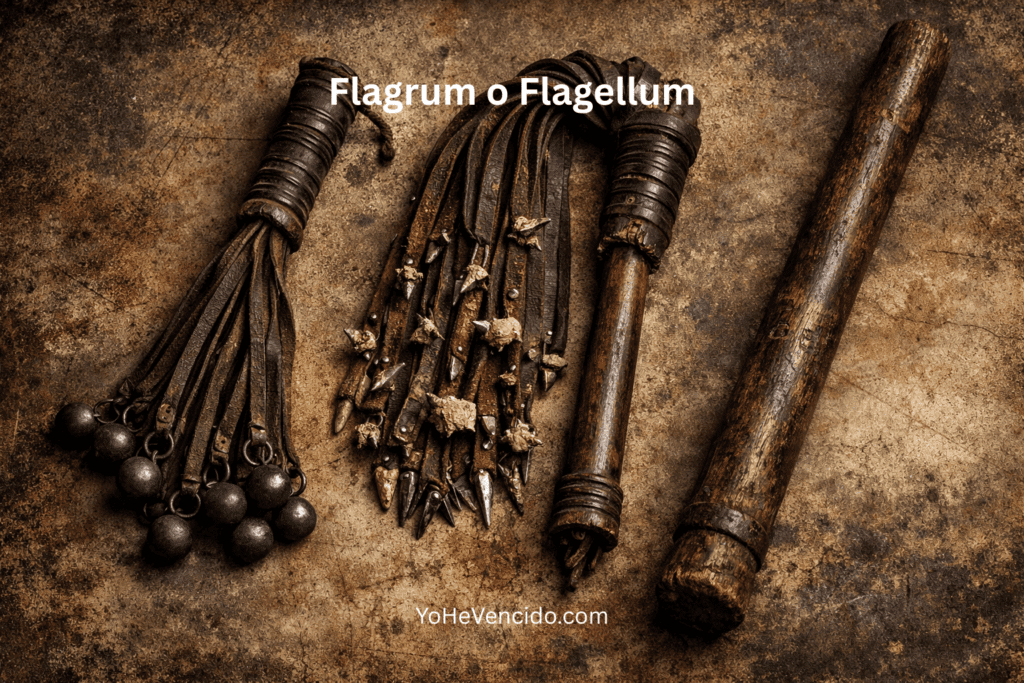
Historical commentary: Roman flagellation in the time of Jesus
Roman flagellation was one of the most brutal punishments of the ancient world. It was not simply a form of physical discipline, but a systematic method designed to severely weaken the condemned person before execution.
The most common instrument was the flag the flagelluma short whip made of several leather straps. The ends were studded with... fragments of metal, sharp bones, or lead ballswhose function was not only to cause pain, but tear the skin and flesh with each blow.
Roman historians describe how, after repeated floggings, the condemned person's back could be exposed down to the muscle and even the bone. In many cases, the victims they did not survive to the scourging, even before reaching the crucifixion.
Although Jewish law limited the lashes to forty (Deuteronomy 25:3), The Romans were not subject to that restrictionAnd in the case of Jesus, who had already been sentenced to death, the soldiers had no incentive to moderate their violence.
Scripture records it with sobriety, without graphic details, but with sufficient clarity:
“Then Pilate took Jesus and had him flogged.”
(John 19:1)
That brief verse encapsulates a historical reality of extreme cruelty. The text's silence does not diminish the suffering; on the contrary, it reflects the gravity of the moment.
Centuries earlier, Isaiah had foretold it with words that carry greater weight today in light of history:
“As many were astonished at you,
so his appearance was disfigured from that of men…”
(Isaiah 52:14)
Jesus was not ceremonially flogged.
He was subjected to a full, real, and devastating Roman punishment.
And yet, It did not withstand.
“Christ suffered for us…
who, when cursed, did not respond with a curse;
When he was suffering, he was not threatening…”
(1 Peter 2:21–23)
This historical fact is not intended to provoke morbid curiosity, but reaffirm a biblical truth:
Christ's suffering was physical, real, profound, and voluntary.
Nothing was symbolic. Nothing was exaggerated. Nothing was unnecessary.
Everything was permitted to fulfill the eternal purpose of redemption.
The greatest weight: our sins upon Him
Although the Roman scourging left Jesus' body broken, that was not the greatest burden He carried. There was a deeper suffering, invisible to human eyes, but infinitely heavier: the sin of the world upon Him.
Physical pain has a limit.
The spiritual weight of sin, no.
Jesus Christ was not only wounded in his flesh; he was burdened with our guilt.Through our rebellion, through our disobedience before a holy God, that which eternally separated us from God was placed upon the sinless Son.
Scripture declares it with absolute clarity:
“To him who knew no sin,
He made him sin for us,
so that in Him we might become the righteousness of God.”
(2 Corinthians 5:21)
This verse contains a shocking truth:
Jesus not only led our sins; It was treated as a sin before the Father.
Isaiah had prophesied it centuries before:
“Jehovah laid on Him the iniquity of us all.”
(Isaiah 53:6)
Every lash was real.
Every nail was real.
But the darkest moment was when the holy Lamb bore the full weight of human guilt.
Peter, a close witness to Christ's suffering, affirms it thus:
“He Himself bore our sins in His body on the tree,
so that we, being dead to sin,
Let us live for justice.”
(1 Peter 2:24)
The weight of sin brought separation.
For the first time in eternity, the Son experienced the abandonment that sin produces. That cry from the cross was neither theatrical nor symbolic:
“My God, my God, why have you forsaken me?”
(Matthew 27:46)
That scream reveals the deepest point of sacrifice.
Jesus took the place that belonged to us.
He endured the separation we deserved, so that we might be reconciled to God.
Pablo sums it up like this:
“And we were dead in our sins…”
He gave us life together with Christ.”
(Ephesians 2:5)
This was the true weight of the cross.
Not just the wood,
not only the pain,
but the sin of all humanity placed upon one holy Man.
And all this did not happen out of obligation, nor out of defeat, but out of obedient love for the Father:
“Nobody takes my life,
but I put it on myself.”
(John 10:18)
Beyond religiosity: a work that only the Holy Spirit can do
Remembering Christ's suffering was not intended by God to become a religious custom or a calendar of external activities. When these days are reduced to rituals, processions, or repetitive practices, the heart is at risk of remaining intact, without repentance or real transformation.
Therefore, when these days are remembered—whether called Lent or Holy Week—the biblical exhortation is clear and urgent:
Don't experience them only as a tradition.
Don't reduce them to religious activities.
Because no external work, however sincere it may seem, can produce what only the Holy Spirit It is capable of doing inside the human being.
Jesus himself stated it:
“The Spirit is the one who gives life;
"The meat is of no use at all."
(John 6:63)
Without the work of the Holy Spirit, the cross can be observed…
but not understood.
She can be remembered…
but not hugged.
It can be celebrated…
but not applied to the heart.
It is the Holy Spirit who convict of sinwho reveals the gravity of our condition and, at the same time, the depth of God's love manifested in Christ:
“And when He comes,
will convince the world of sin,
of justice and judgment.”
(John 16:8)
Therefore, this is not a call to do more, but to stop.
Detente.
Meditate.
Consider.
Allow the Holy Spirit to illuminate the cross before your eyes and bring it to your conscience. Don't just look at the wood, Look to the Lamb.Don't just focus on the physical pain, discern the spiritual price.
The apostle Paul expresses it this way:
“The natural man does not perceive the things of the Spirit of God,
because to him they are madness.”
(1 Corinthians 2:14)
Recognizing the suffering of Christ is not a product of human sensitivity, but of spiritual revelation.It is the Holy Spirit who leads us to respond correctly: not with rituals, but with a broken heart; not with religiosity, but with obedient gratitude.
“The sacrifices of God are a broken spirit;
“A broken and contrite heart, O God, you will not despise.”
(Psalm 51:17)
When the Holy Spirit works, the cross ceases to be a distant symbol and becomes a personal point of encounter. There, the believer understands that the price has been paid, that grace has been offered, and that the correct response is not tradition, but surrender..
And it is then—only then—that the memory of Christ's suffering produces life, transformation, and a new walk before God.
The answer that the cross demands
Contemplating the suffering of Christ is not an intellectual exercise nor a fleeting emotional reflection. The cross demands a response.No one can honestly look at the sacrifice of Jesus and remain neutral.
Scripture reminds us that the gospel is not just a message to be heard, but a truth to be lived. believe, embrace and live:
“I have been crucified with Christ,
and I am no longer alive,
But Christ lives in me…”
(Galatians 2:20)
If Christ bore our sins, then our lives no longer belong to us. The cross not only saves us from judgment; It calls us to a life of surrender.Believing in Christ means dying to sin and living for God.
Paul expresses it clearly:
“What then shall we say?”
Shall we persevere in sin so that grace may abound?
Absolutely not.
(Romans 6:1–2)
Responding to the cross is not perfection, but it is address.
It is not external religiosity, but internal transformation.
It is not tradition, but obedience born of love.
Jesus himself said it:
“If anyone wants to come after me,
deny yourself,
Take up your cross daily,
and follow me.”
(Luke 9:23)
Taking up the cross does not mean seeking suffering, but relinquish control.It means rejecting pride and self-sufficiency. It means living with the awareness that the price has already been paid and that our response should be gratitude expressed in a holy life.
Peter exhorts the believers in this way:
“Be holy in all your conduct.”
(1 Peter 1:15)
The cross confronts us with an inevitable question:
What are we doing with Christ's sacrifice?
Ignoring it hardens the heart.
Receiving it with faith produces life.
Conclusion: love that triumphed through pain
Christ's suffering was neither accidental nor unnecessary.
Every step toward the cross was part of an eternal plan designed in God's love. Jesus not only endured the most cruel physical punishment of his time; He willingly bore the weight of the sin that separated us from God.
The cross reveals two inseparable truths:
the seriousness of sin
and the greatness of divine love.
Nothing shows more clearly how much God loves us than the fact that he gave his own Son to redeem us. Scripture declares this in words that do not lose their power with time:
“For God so loved the world,
who gave his only begotten Son,
so that everyone who believes in Him,
Don't get lost,
but have eternal life.”
(John 3:16)
This love was not theoretical.
It was demonstrated in blood, in obedience, and in total surrender.
The cross is not only the place where Christ died;
is the place where Our hope was born.
The debt was paid there.
There the path opened up.
There, death was defeated.
Therefore, remembering the suffering of Christ should not lead us only to emotion, but to... surrender.Not to tradition, but to... living faith.Not to external religiosity, but to a life transformed by grace.
Those who contemplate the cross with a sincere heart understand that they cannot continue living in the same way. The love that was poured out there calls us to walk in obedience, gratitude, and holiness.
Praises to Jehovah, God of Israel,
For ever and ever.
Amen and Amen
Psalm 41:13