
Artificial Intelligence and the New World Being Born
When the copilot begins to take the controls
Introduction
We are living in one of the most important technological moments in human history. The most impressive thing is not only the speed at which artificial intelligence is advancing, but also how quickly human beings are adapting to depending on it.
Just a few years ago, talking to a computer as if it were a person seemed like something out of a science fiction movie. Today, millions of people talk daily with artificial intelligence systems to work, learn, create content, seek advice, organize ideas, and solve everyday problems.
And being completely honest… I myself am part of that change and use artificial intelligence.
I use it to learn, organize my thoughts, and develop projects, among other things.
That is precisely why this topic captures my attention so much.
Because the more useful this technology becomes, the easier it is to hand over small parts of our dependence and our time without realizing how much it is changing the way we think and live.
And no, this article is not trying to say that “robots will take over the planet tomorrow,” but we are indeed paving the way toward a future in which artificial intelligence takes control of where humanity will go.
Nor is this about attacking technology.
The reality is much deeper than that.
What I want to present here is how humanity has progressively accepted technological systems that are increasingly integrated into our lives… to the point we are at now, where artificial intelligence is slowly beginning to move from being a simple tool to becoming something increasingly close to a constant copilot in daily life.
And perhaps the most important question is not how far artificial intelligence will advance…
The real question is:
What level of control will we be willing to comfortably give up during the process?
When Science Fiction Seemed Impossible
Hollywood, robots, and human imagination
Those who grew up watching classic science fiction movies and series will remember how Hollywood spent decades showing us intelligent computers, humanoid robots, and machines capable of making decisions on their own.
Series like Lost in Space featured characters such as the famous B-9 robot, an intelligent machine that helped human beings, analyzed situations, and warned of dangers. And who remembers the famous series Star Trek? With Captain James Kirk and Mr. Spock and the entire advanced artificial intelligence system of the USS Enterprise. For many children and families of that time, it was simply television entertainment.
But looking back, it is interesting to see how Hollywood not only entertained us… but also slowly accustomed the human mind to imagining a future in which artificial intelligence lived alongside us.
Decade after decade, films began to appear in which intelligent computers controlled entire systems, assisted pilots, managed cities, or even replaced certain human functions.
At that time, most people saw those ideas as pure fantasy.
Our grandparents could hardly have imagined a world in which people carried small computers in their pockets all day, constantly talked to virtual assistants, or asked an artificial intelligence for advice.
And honestly… many of us did not imagine it either.
However, while Hollywood was planting futuristic ideas in the collective imagination, the scientific world was quietly moving forward.
The Birth of Personal Computers
When technology began entering homes
Since the 1950s and 1960s, governments, universities, and major technology companies had already been experimenting with advanced computers capable of processing information at impressive speeds for that time.
However, those gigantic machines took up entire rooms and seemed reserved only for scientists, the military, and large corporations.
No one imagined that one day there would be computers in practically every home.
But then something happened that began to change the world forever.
In the late 1970s, the first computers designed for home use began to appear. Devices such as the Apple II and other similar systems slowly began bringing computing into everyday life.
Today it seems completely normal.
But at that time it was revolutionary.
Many people did not understand why anyone would need a computer at home. Others thought it was simply a passing trend. Some even felt fear or distrust toward that new technology.
However, the world had already begun to change.
And it was only the beginning.
The World Went Online
The silent internet revolution
During the 1980s and early 1990s, personal computers began to spread rapidly. What once seemed strange slowly began to become part of modern life.
But the real change had not yet arrived.
The biggest transformation happened when computers stopped working in isolation and began connecting to one another.
Then came the internet.
For younger generations, it is hard to imagine, but there was a time when the internet was not part of daily life. There were no social networks. There were no video platforms. There were no mobile apps connected 24 hours a day.
Many people thought the internet would never have any practical use in everyday life.
But little by little, almost without the world noticing, humanity began to connect.
First came email.
Then chat rooms.
Later, web pages.
Then online shopping, digital banking, and social media.
What began as a technological tool slowly became an essential part of modern life.
And without realizing it, millions of people began to depend completely on digital systems to work, communicate, study, shop, be entertained, and even connect emotionally with other human beings.
Technology was no longer only on a desk; now it was beginning to move around with us.
Now it was beginning to shape the way humanity thought, reacted, and lived.
When Technology Entered Our Pockets
The era of smartphones
If the internet changed the planet, smartphones changed human behavior.
Technology stopped staying in an office or on a desk.
Now it traveled constantly in our pockets.
With the arrival of smartphones, human beings began living connected practically 24 hours a day. Social media began transforming communication. Notifications began constantly competing for our attention. Algorithms started studying our tastes, emotions, habits, and preferences.
And almost without realizing it, the phone went from being a communication tool to becoming a constant extension of human life.
Today, many people use their phones to:
- work
- browse
- study
- shop
- entertain themselves
- get directions
- store memories
- manage money
- connect socially
And although this technology has brought impressive advances, it has also created an enormous dependence that previous generations could never have imagined.
The most interesting thing is that this change happened gradually.
Humanity did not become technologically dependent all at once.
It happened little by little… out of convenience.
The Birth of the New Copilot
The arrival of modern artificial intelligence
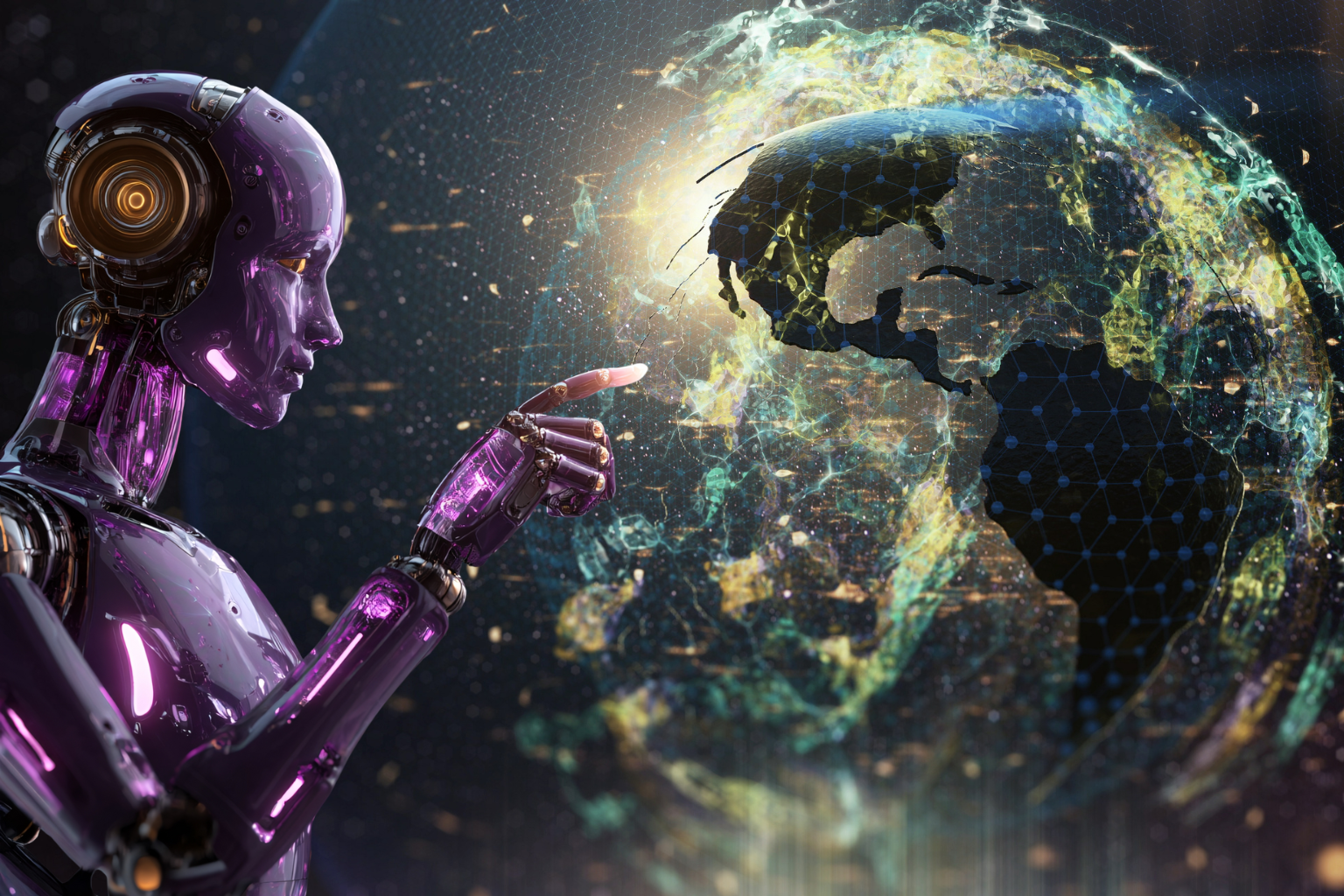
Then modern artificial intelligence arrived. Human beings discovered the many advantages offered by AI (Artificial Intelligence), and since the seed of technology and futurism had already been planted in us, it became easy for us to accept it and use it.
Taking as an example an airplane that is about to fly, it requires a pilot and a copilot. The human being is the pilot, and artificial intelligence is that copilot born from the technology that surrounds us and that we use every day for almost everything.
Systems such as ChatGPT, Grok and other platforms have begun to rapidly transform the relationship between human beings and technology.
For the first time, millions of people began interacting daily with systems capable of:
- answering complex questions
- writing content
- generating images
- organizing information
- creating code
- imitating human voices
- holding natural conversations
- analyzing data in seconds
And all of this happened extremely quickly.
What seemed impossible just a few years ago is now part of daily life for millions of people around the world.
And this is where I personally find something deeply interesting.
Because I feel we are living through a technological transition that can be perfectly described with an aviation analogy.
From Copilot to Main Pilot
The Silent Transition That Many Are Not Seeing
Stage 1 — AI as copilot
At first, artificial intelligence functions as a copilot. Sitting next to the pilot, who commands the flight, assisting them during it.
- It helps.
- It assists.
- It suggests.
- It organizes.
The human being still maintains full control.
But, little by little, artificial intelligence helps us so much that we begin to trust it more.
We allow artificial intelligence to write for us.
Think for us.
Organize decisions for us.
Filter information for us.
Recommend what to read, what to watch, and even what to believe.
Then we reach a second stage.
Stage 2 —AI taking partial control
The human is still present… but supervises less and less.
- automatic recommendations
- algorithms deciding content
- AI writing emails
- AI creating images
- AI making financial decisions
- AI filtering news
This is where humans begin to trust too much.
Artificial intelligence continues to be an “assistant”… but we supervise it less and less.
- We trust more.
- We verify less.
- We depend on it more.
Stage 3 — Advanced autopilot
The human is still sitting in the cockpit…
…but they are no longer the pilot flying the plane.
And perhaps that is where the real psychological shift begins.
The artificial intelligence system slowly begins to take more control.
And the most surprising thing of all is that this process does not happen out of obligation.
It happens because convenience accelerates acceptance.
Artificial intelligence responds quickly.
It simplifies tasks.
It reduces effort.
It saves time.
And the more useful it becomes, the easier it is to depend on it.
Stage 4 — “Full Pilot”
We are rapidly approaching this stage. Here, the system doesn’t just assist.
Now it:
- directs
- interprets
- decides
- controls workflows
- manages information
- influences human behavior
And human beings adapt because it all happened gradually.
The Real Danger Is Not a Robot
Human dependence and the loss of discernment
Honestly, I don’t think the most important part of this conversation is imagining robots walking down the streets like in the movies.
I think the deeper issue is something else.
Human dependence.
“Humanity will not hand over control all at once.
It will do so little by little… out of convenience.”
We are entering a stage in which many people are beginning to turn to artificial intelligence before doing their own research. Some are already seeking emotional advice, personal guidance, or interpretation of information directly through automated systems.
And this has only just begun.
The most surprising thing is not the speed at which artificial intelligence is advancing.
What is truly surprising is the speed at which human beings are becoming accustomed to depending on it.
Because people now:
- consult AI before doing research
- ask AI before thinking
- look to AI for emotional guidance
- receive advice from AI
- replace human interaction with AI
New generations will grow up seeing this interaction as something completely normal.
Just as the internet stopped seeming strange…
just as smartphones stopped seeming unnecessary…
Artificial intelligence is quickly becoming a natural part of human life.
And, honestly, that should at least lead us to reflect.
Not in order to live in fear.
But to remain aware and learn to discern.
Because every powerful tool can be used for good… or for evil, depending on the human heart that controls it.
Discernment in a New Technological Era
The importance of staying awake
The Bible speaks repeatedly about discernment, wisdom, and the ability to distinguish between truth and deception.
There are several points that should be kept in mind as Christian people:
- global control
- humanity depending more on systems than on God
- the danger of losing the ability to think critically
- how the Bible speaks of powerful deceptions in the last days
In the Holy Scriptures, Jesus warned about times when deception would greatly increase:
“For false Christs and false prophets will arise and perform great signs and wonders, so as to deceive, if possible, even the elect.”
— Matthew 24:24
We also see in Daniel 12:4 an interesting reference to the increase of knowledge:
“…many shall run to and fro, and knowledge shall increase.”
And in 1 John 4:1 we find an extremely important exhortation for our times:
“Beloved, do not believe every spirit, but test the spirits to see whether they are from God…”
The deception so powerful that we read about in 2 Thessalonians 2:9-11, and that even Christians who are not firm will believe it:
“the lawless one whose coming is by the work of Satan, with great power and lying signs and wonders,and with every wicked deception for those who are perishing, because they did not receive the love of the truth so as to be saved. For this reason God sends them a powerful delusion, so that they will believe the lie”
We live in an era in which information, images, voices, and even visual content can be generated artificially in a matter of seconds.
That is why discernment will become increasingly important.
Not only technological discernment.
Also human discernment and, above all, spiritual discernment.
Conclusion
The plane has already taken off
Humanity is entering a new technological era.
And honestly… I think we are only seeing the beginning.
What seemed like science fiction a few years ago is now part of our daily routine. And the changes continue to accelerate at an impressive pace.
Perhaps the real question is how much control we will be willing to gradually give up as convenience continues to increase.
Technology will keep advancing.
Artificial intelligence will keep growing.
Automated systems will continue to expand.
The plane is already in flight…
For decades, we imagined a future in which machines would be capable of thinking. Today, we are beginning to live it. However, while we celebrate each new technological breakthrough, perhaps we should stop for a moment and ask ourselves: when the copilot is capable of doing almost everything, will we continue to fulfill our role in the cockpit… or will we have become so accustomed to comfort that we forget how to fly on our own?
Coming soon in this series
This article is part of a special series on artificial intelligence, emerging technology, and Christian discernment.
Coming soon:
- What is Agentic AI and why is everyone talking about it?
- AGI: The race toward human-like intelligence.
- Quantum Computing: The technology that could change everything.
- Technology, ethics, and the human heart.
- Artificial Intelligence and biblical prophecy: a Christian reflection.